
So much of the current debate about education feels disconcerting. It isn’t only that the loudest voices often seem to belong to those farthest from the classroom; it’s that the arguments themselves seem to miss the point. Education has become a strange narrative of competing absolutes – of sides to be taken – when, in truth, its effectiveness often lies in the tensions between them.
A City of Dualities
Visiting Edinburgh after a busy term at school, I was struck by the stark contrasts of this historic city. Walk from the Grassmarket, up West Bow to the Royal Mile at dusk and you feel the city’s two distinct faces at once: medieval wynds slip into shadow while the New Town sits across the valley, orderly and brightly lit. Robert Louis Stevenson described a sense of “a double existence” here and he felt strongly that this place could hold opposing truths without needing to reconcile them.
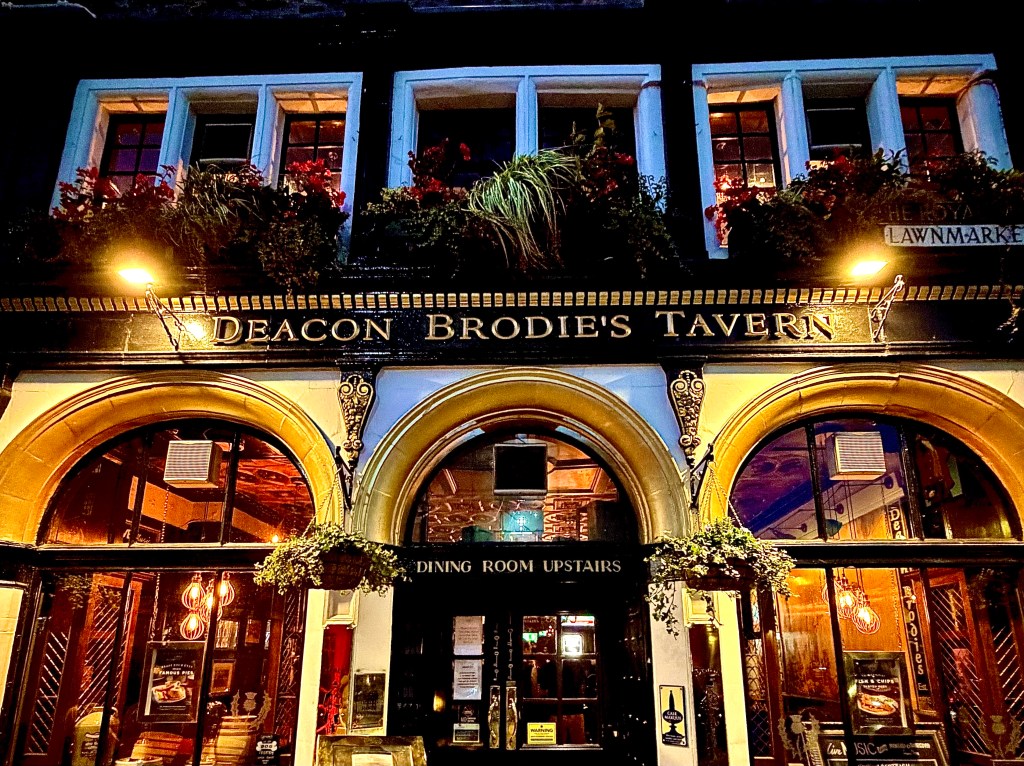
It’s no surprise, then, that The Strange Case of Dr Jekyll and Mr Hyde was conceived here. The story’s real-life precursor, Deacon Brodie – respected, upstanding craftsman by day, shadowy thief by night – still haunts the city’s gothic edges and lends his name to a pub on the Royal Mile. Stevenson’s tale endures because it captures something recognizably human: the restless pull between order and freedom, certainty and volatility, tradition and change – the same tensions that define every school.
The Dualism of Educational Debate
Literary scholars often interpret Jekyll and Hyde through the lens of dualism, “the belief that the world can only be explained through the coexistence of two opposing and irreducible principles.” Modern education debates echo this same structure – two halves locked in argument, each claiming to define the whole:
We talk as if we must choose sides, as if one half of our educational nature must suppress the other. Pick a side, the dogmatists tell us. Edinburgh reminds one that it is possible to hold dichotomies in tension and to design for both. In the tradition of Scottish thought, there’s even a name for this – Caledonian Antisyzygy – the “duelling polarities within one entity”. Perhaps this is the mindset schools need now. The strength of a school lies not in its uniformity but in its ability to accommodate tensions creatively, intelligently, and humanely.
Personalisation: The Art of Integration
Schools are not battlegrounds for competing ideologies; they must be ecosystems for diverse learners. Learning is personal, and personalisation is not the soft middle ground between extremes. It is the disciplined art of integration: the precision of doing the right thing at the right time for each student. Sometimes, for instance, this is direct instruction; sometimes it’s inquiry. Often a digital tool will improve the task; at other times a pen and paper is the best approach. True personalisation requires schools to provide:
Nuance Endures
Places like Edinburgh remind us that nuance endures, that opposites can coexist without cancelling each other out. The Old Town’s atmospheric, meandering streets and the New Town’s reassuring symmetry aren’t competing opposites; they’re two sides of the same entity. Unlike Stevenson’s story, everything isn’t a black and white battle between good and evil, right and wrong. Learners deserve schools that have the confidence to balance competing truths, resist false dichotomies, and invest their energies in learner-centred ambition and purpose.
Notes
Robert Louis Stevenson. The Strange Case of Dr Jekyll and Mr Hyde. 1886.
Shubh M Singh & Subho Chakrabarti. A Study in Dualism: The Strange Case of Dr. Jekyll and Mr. Hyde. 2008.
See more about the sometimes controversial notion of Caledonian Antisyzygy here.
 maelstrom